Horizontes de Sentido by Yoab Vera
Yoab Vera. Horizontes de sentido
The work of Yoab Vera is constructed from signs and phenomena that appear elementary: suns, sunsets, flowers, horizons. However, far from operating as simple natural motifs, these elements function as temporal devices. Before them, we are invited to enter a time that does not allow for the haste of contemporary life. In his canvases, urgency cannot be imposed: time expands, is suspended, and demands to be inhabited with attention.
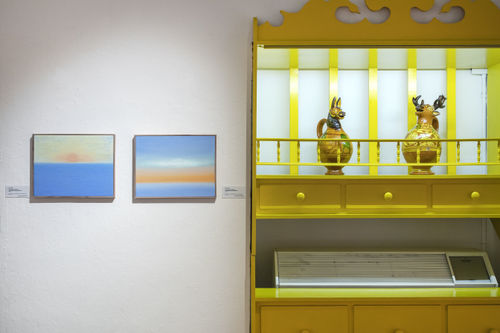
This exhibition brings together a selection of recent works by Yoab Vera that will temporarily inhabit the Museo Dolores Olmedo, an oasis-almost an Eden-made of gardens, water, and architecture, embedded within the density of the urban sprawl. In this context, the work becomes attuned and expands, finding in this landscape a counterpart through which to reflect upon and experience silence.
Yoab Vera's practice maintains a special connection to time, inscribed in the very act of making through a slow process, attentive to layers and open to the uncertainty of the result, which only reveals itself over the course of the work. Even the titles of his series-such as those he calls "Semanas (weeks)"-record that concrete, lived temporality.
His work is situated between the concrete and the abstract: they do not depict a recognizable place, yet they do not detach themselves from the sensory world. Within them, space seems to dilate toward the eternal, toward a spiritual dimension where the horizon is no longer merely a line, but a field of inner resonance-an opportunity for prolonged contemplation.
These paintings invite us to rehearse a politics of pause, to relearn time, and to reflect, from stillness, on the very experience of existence.
Puestas de sol
In 1956, Diego Rivera (1886-1957) spent a season at Dolores Olmedo's house in Acapulco, resting after an intense treatment he had undergone to cure the cancer that would ultimately end his life. With his body weakened and facing the prospect of his own death, he produced an extraordinary series of sunsets in which he seems more attentive to the elemental rhythms of life-the light, the passage of the day, the sound of the sea-than to his perennial controversies.
Confronted with his own fragility, he returned at this stage of his life to the horizon. From that place-both physical and existential-he turned to the sunset as a metaphor: the sun that rises and falls as a representation of circular time, the certainty that everything dies and returns, that light is extinguished only to reappear.
In this space, Yoab Vera's sunsets enter into dialogue with some of the final works of the Mexican muralist. These horizons do not describe a specific place; rather, they construct a threshold: a point at which the gaze does not come to rest and time becomes elusive, as if the landscape were not offered to be possessed, but to be inhabited momentarily.
If in Rivera the sunset is a serene form of farewell, in Vera the horizon is an act of pause, a hope that orients. Both coincide in understanding the landscape not as a backdrop, but as an inner event.
The works gathered in this gallery invite us to situate ourselves in "that other realm that a soul inhabits and safeguards," to look without haste, to accept that what appears still is, in fact, disappearing. Here, contemplation is not about stopping the world, but about accompanying it in its passage.
[1] María Zambrano in her text Claros del bosque (1977).
Se mira desde aquí y no desde allá
Yoab Vera's constant concern with becoming aware of the present gives rise to an energetic critique of the hyper-productivity of contemporary life and aligns his work with a current of thought that advocates boredom as the seed of creativity, in opposition to the excess of stimuli. Concepts such as orientation, hope, and pause run through his practice, more as sensorial experiences than as directives to be carried out.
Yoab Vera's painting does not propose an escape or a nostalgic refuge from the noise of the present, but rather a critical operation on the experience of time itself. His work dismantles the normalization of speed as the dominant way of life. Each piece functions as a temporal threshold that suspends the logic of productivity and restores the possibility of a sensitive orientation in the world.
To look at these works is to accept that all contemplation takes place from a concrete, finite, human position. Nature does not promise permanence; instead, it offers the possibility of fully inhabiting the instant.
"My way of painting is contemplative. Painting implies staying with what appears, looking again, holding time within the work. That pause is a decision."
-Yoab Vera.
-Marisol Argüelles.


